
best-seller

You have an outdated webbrowser. The website might not work correctly.
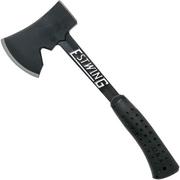
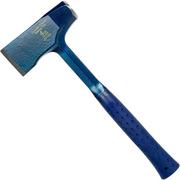
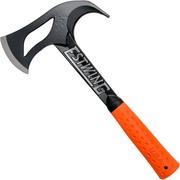
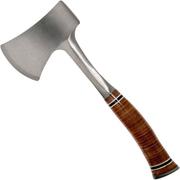
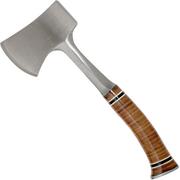
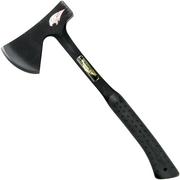
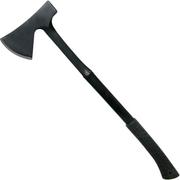
Estwing hammers and tools occupy a unique position in the world of both DIY enthusiasts and professional craftsmen. These hammers are known in the United States as the world's first, best and, in the eye of most, the only truly solid forged hammers. Estwing axes enjoy the same reputation; they are also forged from a single piece from head to handle, making them extremely tough and robust. All hammers and axes are equipped with a handle made of, for example, leather stacked rings or Estwing's well-known “Shock Reduction Grip” to absorb shocks as much as possible during hammering or chopping.















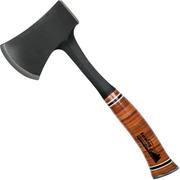

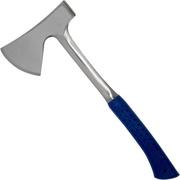


Estwing tools are known as the world's first; from solid steel hammers, axes and other tools. With this recognition, the company has grown from a one-man business to a leader in this field. Estwing also continues to innovate in terms of design and the materials they use.
Estwing tools are known for their highly shock-absorbent handles. For example, there are hammers and axes with Estwing's iconic and traditional stacked leather handles. These are highly resistant to impact and also relatively non-slip thanks to the natural properties of the leather. More modern Estwing tools feature the patented “Shock Reduction Grip”. The “Shock Reduction Grip“ is made from a specially formulated synthetic composite, giving it a different structure and durability than normal rubber. This material reduces vibrations more effectively and is even more resistant to the elements.
The robustness of Estwing tools can be attributed to their construction from a single solid piece of steel. By forging the tools in their entirety, Estwing eliminates weak points such as welded joints, adhesive fastenings or clamped parts. This is rare in the world of hammers, axes and tools in general, and ensures that you can fully rely on the power of your tool, even during intensive use.
To further enhance their robustness, all Estwing tools are manufactured from high-quality American carbon steel. This is very tough and is extremely impact-resistant due to its simpler chemical composition and absence of high chromium content. This makes them less brittle, more impact-resistant and better at absorbing shocks. This is one of the reasons why carbon steel is generally ideal for tools that need to be able to withstand heavy use, such as hammers, axes and machetes.
A curved claw hammer has a curved V-shaped claw at the back of the head, ideal for pulling out nails. The curved claw provides extra leverage, making it easier to pull nails out of wood. These hammers are mainly used in the carpentry and woodworking industries.
A straight claw hammer, also known as a “rip claw hammer”, has a straight claw. This design offers extra power for prying and demolition work, or the option to hammer nails deep into the wood. The straight claw can also more easily pull nails out of rough timber or pry up floorboards.
An axe is pretty self-explanatory. Applications include splitting firewood, general woodworking, and felling trees or branches. Depending on shape and weight, the application may vary: splitting axes, for example, have a wedge shape for splitting wood into pieces.
A throwing axe is specially designed for, well, throwing! They are well balanced and often smaller with a relatively heavy head, so that they remain stable during the throw and land at the right angle in the goal. Throwing axes often have two heads to make it easier to hit your target. This type of axe is used in sports and recreation, for example in axe throwing competitions.
A tomahawk is a lightweight axe derived from the well-known traditional American hand axe. Modern tomahawks are versatile: they often combine an axe head with a hammer or spike on the back, suitable for chopping or breaking. A tomahawk is lighter and more compact than a regular axe, making it quick and easy to control when making a fire. Professionals also use tomahawks as a tactical tool, for example to break windows.
A ball-peen hammer is a specialised hammer used for metalworking, among other things. It has a flat striking side on one end and a hemispherical end on the other, which can be used to shape or dent sheet metal. Typical applications include beating hollow shapes into metal sheets.
A dead-blow hammer has a hollow head filled with steel or zinc pellets. This prevents it from rebounding after the strike, ensuring that the full force of the blow is transferred to the workpiece. This, in combination with the nylon or plastic head, reduces vibrations and strain on the hand and arm, and also prevents damage to the workpiece.
A carpenter's hatchet is specifically designed for woodworking. The blade is considerably thinner than that of a splitting axe, for example, making it ideal for precise cuts in wood. Many carpenter's hatchets have a nail puller in the back, but this type of axe is mainly used for cutting wood and making wood joints. As the name suggests, this tool is typically used by carpenters and furniture makers.
A hammer holster, also known as a belt holder or hammer holder, is a holder that attaches to a tool belt to hold a hammer. It is often made of leather or durable fabric and prevents the hammer from swinging around or falling while moving.
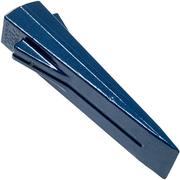
Splitting wedges, also known as felling wedges, are strong steel wedges that are driven into tree trunks to split wood. Thanks to their wedge shape and frequently applied grooves, they quickly break down wood fibres. Such a wedge stays in the wood better and causes much larger cracks in the wood, causing even hard or knotty trunks to split into pieces. Splitting wedges are driven in with a heavy hammer, for example, and are crucial for making firewood.
Estwing blades, like their axes and hammers, are forged from one solid piece of steel. This gives them the same robustness, allowing them to handle surprisingly heavy tasks without too much difficulty. The handles are moulded and offer a solid grip. Fewer parts means less can go wrong!
At the beginning of the twentieth century, hand tools often failed at their weakest point: the connection between the head and the handle. Loose hammer or axe heads were not only unreliable, but downright dangerous. In 1923, Ernest O. Estwing founded Estwing with a clear and straightforward goal: to make tools that are as robust as possible. His solution was simple but effective: tools forged from a single piece of steel. By eliminating all connections, the greatest risk disappeared at once.
Estwing was one of the first, if not the first, to produce solid metal tools. The first Estwing hammers were finished with a laminated stacked leather grip. A second breakthrough followed later: the ingenious “Shock Reduction Grip”. After more than two years of intensive testing, Estwing succeeded in developing a plastic handle that drastically reduced vibrations and proved to be exceptionally durable in use.
Hammers were just the beginning. Estwing applied the same principle to axes, for example. This is how the solid axes made from a single piece of steel came into being; designed to deliver the same strength and reliability as their hammers.